All posts by Salesian Province of Dimapur (IND)

The Province of Dimapur is one of the three Salesian Provinces in the North East. It was bifurcated from the Province of Guwahati in the year 1982. Today the province is spread into Arunchal Pradesh, Upper Assam, Nagaland and Manipur.

Another Salesian Cooperator Goes to Meet the Lord

Mao: 07 October 2020 – It was sad day for the Mao Salesian Cooperators’ Unit on 7 Oct 2020. Mrs. Christian Onia belonging to the cooperators unit of Mao passed away today (07 October 2020) at her village in Mao. Fr. C D Mathai, the parish priest of Mary Help of Christians parish presided over the last rite. 

She was born on 07 July 1950. She did her BA and B ED and served as Government assistant graduated teacher. She also got state teacher award. She retired from her teaching profession in year 2009. It was on 12 April 1992 that she took the promise as a Salesian Cooperator. The community of Salesian cooperators of local unit and at Provincial level deeply express our sentiments of sorrow and condolences to the bereaved family and assure our prayers for the departed soul.

Being or Doing

Dimapur 24 September 2020: The Salesian Cooperators of Dimapur Unit met online for their first ever such meeting during this lockdown. All the members of the group participated in the online meeting which was chaired by Fr. Benny James SDB, the new local delegate on 24 September 2020 at 4.30 pm to 6.15 pm. Kaisa Josephine had convened the meeting to recoup the members during the pandemic Covid-19. All the participants took active participation in the meeting.

The meeting was resourceful, enriching, lively and creative. The participants spontaneously expressed their views and plans for the future. The participating members have agreed for creative apostolate for a vibrant and visible Salesian Cooperators’ Unit in Dimapur.

In his concluding remarks Fr. Benny James invited the participants to pay greater attention to what they are rather than getting lost in doing too many things. Doing should be the result of one’s being. One’s love for Don Bosco and focus on the young people, particularly those who are poor. This focal point should encourage each Salesian Cooperator to greater commitment for the emancipation of the underprivileged.

22 Week: Thursday 3 September 2020

Readings: 1 Cor 3:18-23 and Lk 5:1-11
Memory of St. Gregory the Great
The Great catch!

“Because of Your Word I will cast the nets”. These words were the meaningful reply of Peter to Jesus in the Gospel of today. But what word? And with what authority? This reminds me of a Priest, who was well known for his pastoral work in the field of family counselling, was asked by a little boy: Father, how can a priest, not married, can give so much of advice to couples without the experience of married life. This is quite similar to the Gospel narration of today. Jesus without any experience of fishing, but with authority like a master tells the well experienced fishermen to cast the net to the deep (duc in alto). Peter and his companions could have laughed at him or ignored his indications, but Peter with great admiration and humility accepts this challenge to go further into the deep waters. They, initially manifested and expressed their failed attempts saying that they worked the whole night tirelessly, but the result was unsatisfactory. They gave a try to the words of Jesus and the result was unimaginable. It was certainly a great Catch. They even had to call other fishermen to pull the net ashore with great quantity of fish. This incident led them to a high admiration for Jesus and greater faith in him. 

Dear brothers and sisters, in the fishing of our life, if we are longing for a great catch, we have to listen and put into practice His Words.  Because His Word can guide and enlighten us from darkness into great ray of hope. It is not a question of professional qualification or hours of hard work that matter but a having heart full of humility and obedience to listen to Jesus and the ability to follow his words and deeds. The man, alone in his tasks, becomes weary in vain: “If the Lord does not build the house, his builders labour in vain” (SI 127). But if he welcomes the inspired Word, he will receive abundant help from the hand of God.

This is the same Word that encourages us today to move forward in our life, in our fishing, in our struggle for peace and profound happiness. Going to deeper waters means for us to seek more knowledge of God, of His Law, of His teachings etc.  The more we immerse ourselves in the Gospel, in the Scriptures, the more we will find answers to our questions, to our anxieties. Man is a being created by God with the aim of living in harmony with Him and with others and this will only happen when he throws himself into the arms of God’s merciful love. Jesus also calls you and me to be fishers of men! He provides the fish for us, but he needs our nets in order to take for Him souls in need of salvation. May our fishing be fruitful and not be restricted to our circle of friendship. Jesus wants us to be fishermen in His Kingdom and the net He gives us is His love and His Word. Do not be afraid! From now on, you will be fishers of men! That’s what Jesus does with you here and now.

With great joy and hope, we have entered in the month of September dedicated to the Word of God (Bible). His Word is a lamp of my steps and light of my path. (Psalm 119). Let us not allow this month to go by without giving little more attention to the Word of God and its influence in our life. Let us remember that the Great Catch depends on our eagerness to  listen to Jesus.   

(By Fr. Jojo Kachappilly SDB)

Month’s Mind

Dimapur 27 August 2020: The Month’s mind of Late Fr. Jose Chacko sdb will be held at Salesian College cemetery. The Holy Eucharist will be presided over by Fr. Nazarius Lakra SDB, vice provincial of Salesian Province of Dimapur. The entire event will be live telecast from the cemetery.

21 Week: Thursday 27 August 2020

Readings:
1 Cor. 1:1-9  and Mt. 24:42-51
Memorial of St. Monica  

Today we celebrate the memory of St. Monica, the mother of St. Augustine. St. Augustine in his young age was influenced by the Manichean heresy, which teaches that all flesh is evil. Consequently, he fall victim to a pleasure seeking immoral life. For which his mother Monica had to spend her silent years in fasting and tearful prayers before the crucifix, for the conversion of Augustine. The faithful prayer of a mother is not wasted. The Lord eventually answered her prayers. In 386, at the age of 31, Augustine was converted to Christianity from the pagan Machanean religion. St. Monica died peacefully in 387, a year after the conversion of her son. 

In the first reading, St. Paul as the faithful shepherd of the Church of Corinth vividly presents himself as the Apostle called by Jesus himself. Being conscious of his God’s call to be an apostle, Paul wishes the sanctifying grace of God to be upon the people of good will, who accepts and calls upon the name of Jesus as their Lord. He encourages the people of Corinth with the assurance of God’s presence in their midst and their activities. Paul strengthens their faith by promising that the faithful God whom they serve will never fail them in their needs. This is the exhortation that Paul had for the people of Corinth. Here Paul claims himself to be a full pledge Apostle like the other twelve. The aspect of him that edifies us is the total responsibility that he had assumed upon himself, to the Mission that he had vowed to the Lord. It does not matter come what may or to what situation he is placed. The exemplary life of Paul teaches us to be a responsible Stewarts for God’s kingdom. If God has entrusted to us the mission, we are sure that He has given us sufficient graces to carry it out. The Lord will not ask us, anything, which is beyond our strength. He knows us perfectly well!

Instead, the gospel invites us to be vigilant upon the evil tendencies that lingers around the human minds and desires. Jesus presents before us two types of servants: the trustworthy and an unfaithful type of servants. The first servant knows the responsibility entrusted to his care by the Master. He carries it out with an outmost love and sense of responsibility. In this context, the elements of love and responsibility go hand in hand with the indispensable element of trust, between the servant and the Master. Love was the driving force that made the first servant carry out his responsibility in the absence of his Master. Whereas, the second servant, knows his responsibility entrusted by the Master, but takes advantage of the Master’s absence and began to live a reckless life, unmindful of the Master’s love and trust. The second servant failed to carry out his assignment responsibly due to lack of mutual confidential rapport with the Master.

Likewise, our eschatological reward will depend on the degree of love we consciously put in our priestly and religious ministry. The sacrificial love we exercise in our ministry is going to have a significant effect even at the glorious coming of our Lord. We are invited to be prepared and stay vigil, so that the arrival of the Master does not take us by surprise!
(By Fr. Rang Anthony SDB)

Don Bosco Past Pupil Becomes Ambassador to Ethiopia

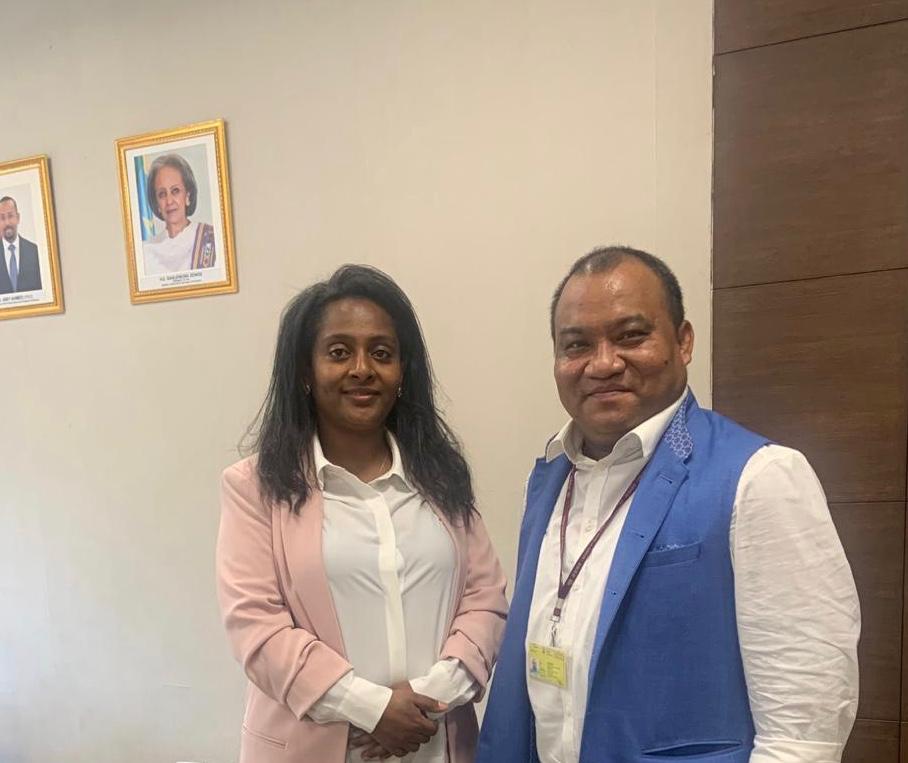
Dimapur 25 August 2020: Robert Shetkintong (Dilbung) has been posted as the next Ambassador of India to the Federal Democratic Republic of Ethiopia. Robert joined the Indian Foreign Service in 2001. In 2003, he was posted to the Indian Mission in Tel Aviv as a language trainee (Hebrew). On completion of language course, he was posted to the Indian Embassy in Rome, and was there for almost 4 years.  He then returned to New Delhi and served at the Headquarters between 2009 and 2012. He subsequently served at the Indian Missions in Ljubljana (Slovenia) and Dar es Salaam (Tanzania).

Mr. Robert along with the Ambassador of Ethiopia in New Delhi

Robert hails from Keithelmanbi Village, St. Paul’s Parish Pallel, Chandel District, Manipur. His parents are Dilbung Samuel Shetwor and Mrs. Dilbung Angela Shangting. They are a devout Catholic family, rich in human and Christian virtues of love, joy, sincerity, hard work, relationship and God fearing. Robert has two sisters – elder sister is Sr. Maria Dilbung FMA and younger sister is Rose Dilbung. His father is one among the trained Catechists during the time of Fr. Larea SDB at Dibrugarh.

As a child, Robert loved to play football and spent hours at play along with his friends but would also dedicate quality time for his studies. He played the role of youth leader and proved to be a great leader and guide. He displayed leadership qualities right from his youthful days.

His schooling began in St. Joseph’s School Sugnu back in 1980s with the encouragement that came through Fr. Sebastian Chelat and many others. In 1986, he shifted to Don Bosco School, Chingmeirong in class 7 and completed the matric examination in 1990. He then went to St. Joseph’s College Bangalore for Classes 11 and 12. He completed BA (Pol Science) from St. Anthony’s Shillong while staying in St. Stephen’s hall, Shillong. He went to New Delhi for pursuing his further studies and completed his MA and M. Phil from Jawaharlal Nehru University.

In 1990 when he and his elder sister were awaiting their matric results, just a few days before the results, it is said that his mother had a commendable dream – she was admiring two beautiful shining jewels in her palm when all of a sudden a religious sister grabbed one of them and went her way and she had just one in her palm. With prayers and wishes of friends and community, Robert’s mother’s dream of the remaining jewel in her palm continues to shine. 

Robert is married to Tingjahat Hangshing and they have two children – Sarah and Raymond.

Saturday 22 August 2020

The Queenship of Our Lady was proclaimed as a liturgical feast by Pope Pus XII on 11 Oct. 1954. She has always been a Mother and Queen to the People redeemed by Her Son. Whenever the Church was in danger Mary like a brave and loving Queen came to the protection of her people. The Church had no hesitation on declaring that the wars She won against the moors, who wanted to make “Vatican a stable for their horses,” was through her power which the Christians obtained through the recitation of the Rosary.

Devotion to Our Blessed Mother is as old as the Church. The apostles afraid of the Jews, who killed Jesus, were hiding away in an upper room, praying and waiting for the Holy Spirit. Mother Mary was their inspiration and support. And truly Mary has proved to be a loving mother to every Child that called upon her.  What a joy to know that there is a mother in heaven praying for us and waiting for us. Hundreds of titles have been given to Our Blessed Lady throughout the long history of the Church. But none is sweeter than the title of Mother, because she truly was the Mother of Jesus, and she was given to each one of us as Mother when Jesus entrusted her to the Apostle John saying, “Son behold your Mother”.

Jesus was so happy to have a Mother like her. Someone has expressed the sentiments of Jesus with regard to his Mother in these words

MY MOTHER
“My most beautiful creation”, says God Is my Mother.
I was in need of a mother, and I created her.
I made my mother before she gave me birth.
Now I am truly human like all other men,
Because I too have a mother,
A real mother of flesh and blood.
My mother’s name is Mary, says God.
Her soul is absolutely pure and full of grace,
My mother is beautiful, so beautiful that
On earth I was never tired of gazing on her,
Listening to her and admiring her.
Leaving the splendour of heaven,
In her I found what I had left behind
Although I know, says God, what it is
To be borne in hands of the angels,
Believe me, that is nothing compared
To be carried in the arms of a mother.

Some years back, priests, when they had to travel early in the morning would take their Breviary (Prayer of the Church) with them and say their prayers while travelling. Once a priest, while travelling by train, took out his prayer book to say his morning prayer. As he opened the book a picture of Our Lady fell from the book on to the floor of the train. A Muslim gentleman sitting opposite to him picked up the picture, looked at it for some time and then asked the priest, “Whose photo is this?”

The priest piously said, “It is my Mother’s photo”

The Muslim gentleman looked at the picture and the priest several times then exclaimed, “But you do not look like your Mother at all”.

Of course, the priest explained to the gentleman why he called Mary his Mother.

But the Muslim gentleman’s words have a lot of meaning. We piously call Mary, “My Mother” Because we love her and have devotion to her.  Devotion means imitation. When we say we have devotion to Our Lady we say we are trying to imitate her in our life. Imitation ultimately make one imitating like one imitated. So, if we call ourselves children of Mary there must be visible in our life virtues that made God choose her to be his Mother. Virtues like, humility, patience, purity, obedience above all charity, love for God and our neighbours. It is not enough to call Mary “our Mother,” but we must become  her worthy children by imitating her, then truly she will accept us as her children and we shall be assured of her lover and protection here on this earth and above  the joy of being with her one day in heaven.

(Fr. Tom Karthik SDB)
Would You like to Hear God?

We turn right and left to hear God today. There are a number of god-man today promising God. But have we ever succeeded in hearing Him? In our blind search for God, we often fall into ditches of mistakes, falsehood and even in wrong hands. God is to be found in peace, in quietness and in the stillness of heart.

The Word of God that comes to us daily in Holy Eucharist is indeed true Word of God speaking to the lost children. He is there! Speaking to us and expecting us listen to him. Words are spoken aloud, however, only when we are quiet, in peace and in humility, we can listen to Him truly.

from the website

The daily scripture is broken for us and explained in understandable terms by spiritual guides and holy priests. You may log on to www.donboscodimapur.org for great satisfaction and for the word of God.

Thursday 20th August 2020

Today the Church keeps the memory  of St. Bernard. Religious Orders, like the people of Israel, had their ups and downs, days of fervor and days of  laxity.  The monastery of  of Citeaux was founded for  the purpose of bringing the Benedcitine Order back to its original life of poverty and religious discipline. In 1112 Bernard joined this monastery  along with  four of his brothers and twenty four friends. Bernard took his religious life and duties seriously, so much so, that after three years of life in the monastery at Citeaux  he was asked to go and start a monastery at Clairvaux. He remained here all his life and  was able to found 68 other Cistercian monasteries. He was a man of wisdom and extraordinary piety. His devotion to the Mother of God was outstanding. It is he  who composed that beautiful prayer to Our Blessed Lady, The Memorare ( Remember, O Most gracious Virgin Mary).

The reading from Ezekiel affirms once again the mercy of God. When his  people went the wrong way he sent Prophets to call them back. When they refused to listen to them, he  had recourse to sterner measures to bring them back, like sending foreign armies to conquer them and lead them away into exile. These harsh punishments he used out of love for his people, to get them back to acknowledge him as the only God and  worship him.  In the readings before these we find God as a threatening God, a punishing God. But here God shows himself as a merciful God. “ I mean to display the holiness of my great name, which has been profaned among the nations, which you have profaned.”

“I am going  to gather you together”, “I will pour clean water ove you” all these words are words of assurance of God’s love for the people.

When we commit sins, God  will deal with us in the same way. He will call us back gently, but if we do not listen to his whispering voice he will send sufferings into our life not to crush us but to wake us up from our slumber in sin and put us back on the way of holiness.

            I knew a young man, called Charles, in Kohima. He had studied in Don Bosco Schools and graduated  from St. Anthony’s college in Shillong. He had been an exemplary Catholic all along, a daily communicant. But as he got a government job in Nagaland and money came into his hands, he  forgot his Christian duties and got into dangerous bad habits. One day in a drunken state he was driving his jeep from Mokokchung  to Mariani.  At one moment he lost control of the jeep and rolled down the hill. The result was a broken spine. He was bed ridden for three years. I used to visit him to hear his confession and give him communion. In one of the last visits he became very emotional and said something that touched me deeply.

He said, “ Father I do no know how I forgot God, but God did not forget me. When my body was alright my soul was dead, but  now that my body is broken my soul has come back to life.” Only  one who trusted in the love of God could have said those words about an accident that broke his spine. And indeed he  came back to God and died a holy death and I conducted his funeral.

And I  have no hesitation to say that God allowed him to fall into that accident only to bring him back. God’s punishments are loving  reminders calling us back to our promise to be faithful to him.

            But unfortunately many look upon these reminders of God as a sign of God’s  anger rather than a sign of his love. And instead of accepting his invitation to put on the wedding garment and sit with him at the wedding table, they keep  running after other occupations. They prefer to sit in the pig sty and eat the good given to the pigs than enjoy sumptuous meal the Father is serving for his dear children.

            God is calling us back, as he called back the people of Israel. Let us not harden our hearts, but rather listen to the loving invitation of the Father to come and take part in the wedding feast he has prepared for us.

Tuesday 18 August 2020

The Church today honours a Saint little known to us. She is from Madagascar and her name is Blessed Victoria Rasoamanarivo (1848 – 1894) just 46 years old. She belonged to a powerful family, educated by the Jesuits and the sisters of the congregation of St. Joseph of Cluny. Her Catholic education made a strong impression on her and she asked to be received into the Church, against the wishes of her parents. When persecution against the Church broke out in her country, her parents persuaded her to return to her pagan religion, but she refused. On the contrary she asked to become a religious, but the sisters, knowing her family background thought it prudent not to accept her.                

She was given in marriage to the son of the Prime Minister, who was also an important army officer. He was a violent alcoholic. To live with him was martyrdom for her. Though her parents urged her to divorce him and come back to her family she refused. She held that Christian marriage is indissoluble. Her exemplary Christian life gained her the admiration of the court and the people. This made her a providential support for the Church after the expulsion of the Catholic missionaries. She publicly defended the Church and kept the faith of the people alive in the midst of persecution. When the missionaries returned in 1886 they found a vigorously flourishing community of Christians, thanks to Bl. Victoria’s virtue and steadfastness. She prayed for her husband and God heard her prayers and he asked for baptism before his death in 1888 because of an accident.

She died in 1894 on 21 August and was beatified by Pope John Paul II in 1989.

In the first reading Ezekiel predicts the anger of God against the ruler of Tyre for his pride and arrogance for claiming to be God. “I am god; I am sitting on the throne of God surrounded by the sea.” The first commandment of God forbids us to give to anyone or anything else the honour due to God. God will not tolerate idolatry. The king of Tyre makes himself god which is worse than honouring someone else as god. Therefore, God vows to send enemies against him to teach him a lesson to throw him down into a pit and die a violent death.

Do we worship other people or other things in the place of God? Many will say ‘No’ But then ask yourself, “To what do you give most of the 24 hours God gives you every day?” And how much time do you give to God?
Some children get up early in the morning to go for tuition. Ask them to come and spend half hour to attend Mass or say their prayers, they will say ‘I have no time.’ Some sit in front of the mirror beautifying themselves or admire their beauty, but they have no time to beautify their soul, or to look at God who gave them, not only their beauty, but everything they have. Whom do we worship, God or something else? Let the response to the Psalm strike a bell in our hearts, “It is the Lord who deals death and life.”

Jesus tells us about the danger of too much wealth. Wealth we all need to live our earthly life, but too much of it, and spending our life only to amass wealth, will make us forget God. That is why Jesus says, “It is easier for a Camel to pass through the eye of a needle than for a rich man to enter the kingdom of heaven.” When our hearts are set on riches, they become our gods, we become idol worshippers and we forget the God who created us and on whom we depend. Do not make wealth your God, rather use the wealth that come into your hands to serve God more earnestly and to care for those who are poor and needy. It is in our power to make wealth a means for our salvation or make it a reason for our damnation.

(By Fr. Tom Karthik SDB)