We wish all the readers of this blog of the Province a very happy feast of Mary Help of Christians. Mary comes to our aid whenever we call on him. She is actively present in the lives of everyone of us. Turn to her, and she will draw close to us.
Category Archives: Mary Help of Christians
Ninth Day with Mary Help of Christians
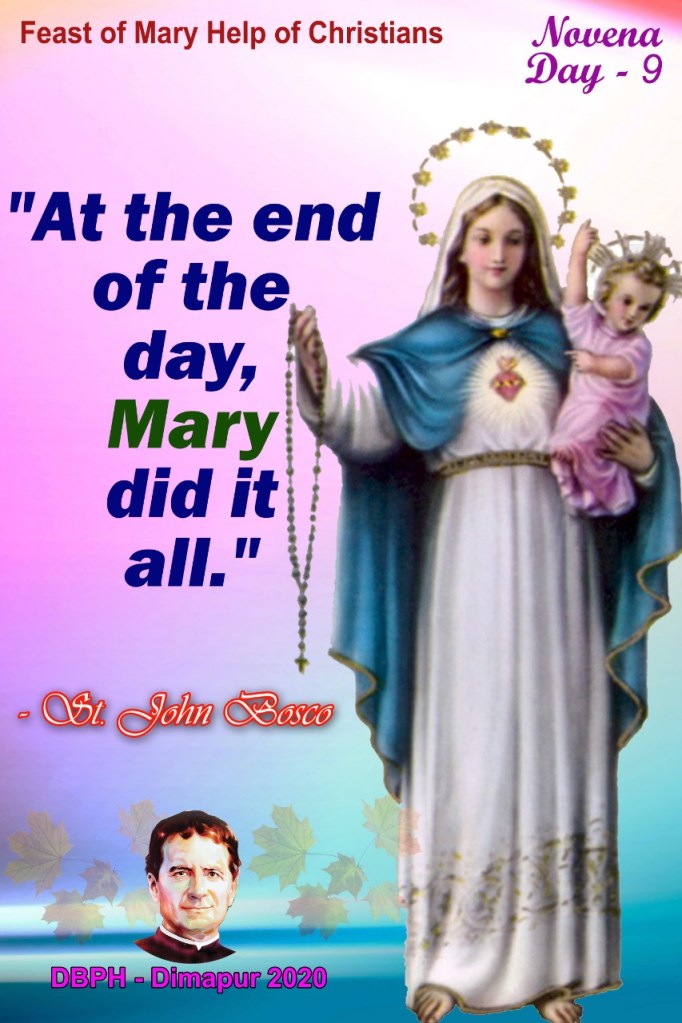
Mary, the Mother who cared for Jesus, now cares with maternal affection and pain for this wounded world. Just as her pierced heart mourned the death of Jesus, so now she grieves for the sufferings of the crucified poor and for the creatures of this world laid waste by human power. Completely transfigured, she now lives with Jesus, and all creatures sing of her fairness. She is the Woman, “clothed in the sun, with the moon under her feet, and on her head a crown of twelve stars” (Rev 12,1). Carried up into heaven, she is the Mother and Queen of all creation. In her glorified body, together with the Risen Christ, part of creation has reached the fullness of its beauty. She treasures the entire life of Jesus in her heart (cf. Lk 2,19.51), and now understands the meaning of all things. Hence, we can ask her to enable us to look at this world with eyes of wisdom.
At her side in the Holy Family of Nazareth, stands the figure of Saint Joseph. Through his work and generous presence, he cared for and defended Mary and Jesus, delivering them from the violence of the unjust by bringing them to Egypt. The Gospel presents Joseph as a just man, hard-working and strong. But he also shows great tenderness, which is not a mark of the weak but of those who are genuinely strong, fully aware of reality and ready to love and serve in humility. That is why Joseph was proclaimed custodian of the universal Church. He too can teach us how to show care; he can inspire us to work with generosity and tenderness in protecting this world which God has entrusted to us. (Francis, Laudato Si’ 241-242)
Eighth Day with Mary Help of Christians
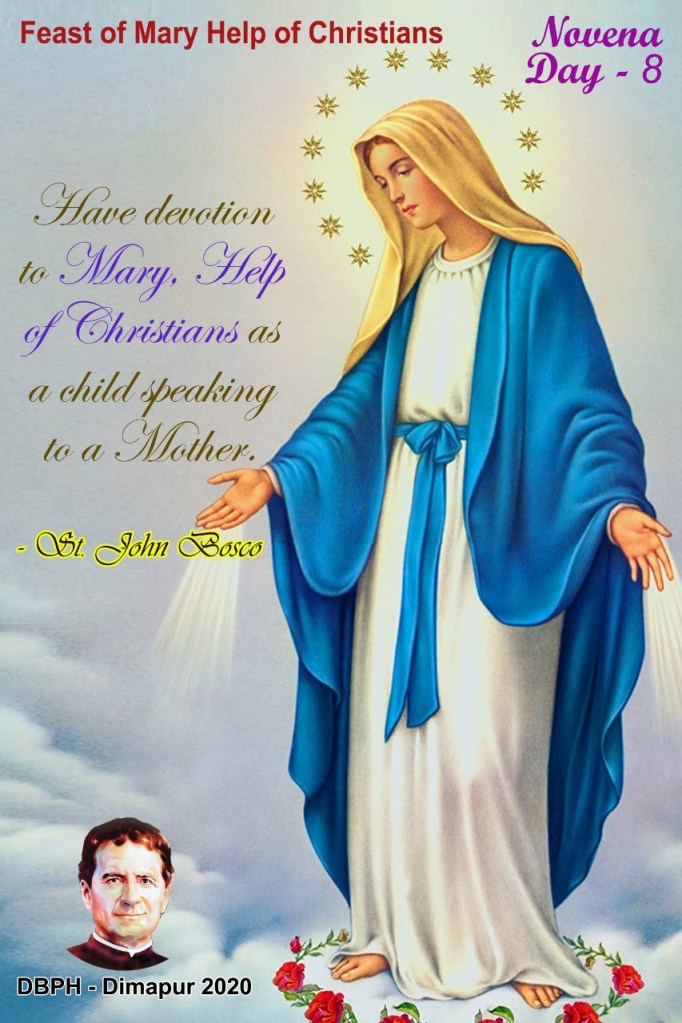
Jesus’ gift to his people
On the cross, when Jesus endured in his own flesh the dramatic encounter of the sin of the world and God’s mercy, he could feel at his feet the consoling presence of his mother and his friend. At that crucial moment, before fully accomplishing the work which his Father had entrusted to him, Jesus said to Mary: “Woman, here is your son”. Then he said to his beloved friend: “Here is your mother” (Jn 19,26-27). These words of the dying Jesus are not chiefly the expression of his devotion and concern for his mother; rather, they are a revelatory formula which manifests the mystery of a special saving mission. Jesus left us his mother to be our mother. Only after doing so did Jesus know that “all was now finished” (Jn 19,28). At the foot of the cross, at the supreme hour of the new creation, Christ led us to Mary. He brought us to her because he did not want us to journey without a mother, and our people read in this maternal image all the mysteries of the Gospel. The Lord did not want to leave the Church without this icon of womanhood. Mary, who brought him into the world with great faith, also accompanies “the rest of her offspring, those who keep the commandments of God and bear testimony to Jesus” (Rev 12,17).
The close connection between Mary, the Church and each member of the faithful, based on the fact that each in his or her own way brings forth Christ, has been beautifully expressed by Blessed Isaac of Stella: “In the inspired Scriptures, what is said in a universal sense of the virgin mother, the Church, is understood in an individual sense of the Virgin Mary… In a way, every Christian is also believed to be a bride of God’s word, a mother of Christ, his daughter and sister, at once virginal and fruitful… Christ dwelt for nine months in the tabernacle of Mary’s womb. He dwells until the end of the ages in the tabernacle of the Church’s faith. He will dwell forever in the knowledge and love of each faithful soul”.
Mary was able to turn a stable into a home for Jesus, with poor swaddling clothes and an abundance of love. She is the handmaid of the Father who sings his praises. She is the friend who is ever concerned that wine not be lacking in our lives. She is the woman whose heart was pierced by a sword and who understands all our pain. As mother of all, she is a sign of hope for peoples suffering the birth pangs of justice. She is the missionary who draws near to us and accompanies us throughout life, opening our hearts to faith by her maternal love. As a true mother, she walks at our side, she shares our struggles and she constantly surrounds us with God’s love. Through her many titles, often linked to her shrines, Mary shares the history of each people which has received the Gospel and she becomes a part of their historic identity. Many Christian parents ask that their children be baptized in a Marian shrine, as a sign of their faith in her motherhood which brings forth new children for God. There, in these many shrines, we can see how Mary brings together her children who with great effort come as pilgrims to see her and to be seen by her. Here they find strength from God to bear the weariness and the suffering in their lives. As she did with Juan Diego, Mary offers them maternal comfort and love, and whispers in their ear: “Let your heart not be troubled… Am I not here, who am your Mother?” (Francis, Evangelii gaudium 285-286)
Seventh Day with Mary Help of Christians
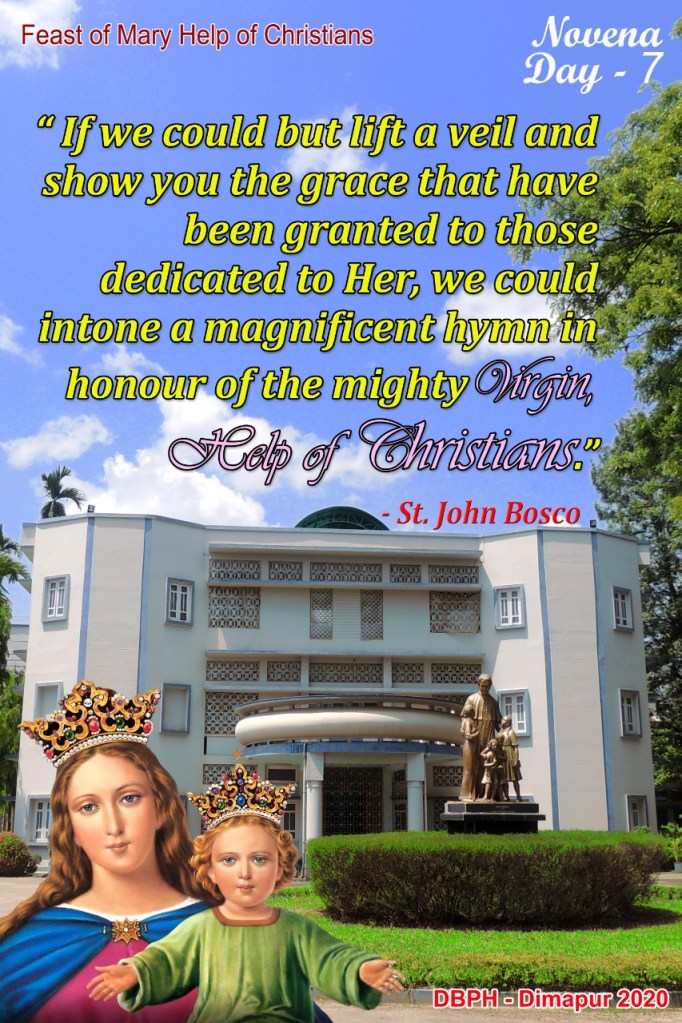
From the relationship between the Eucharist and the individual sacraments, and from the eschatological significance of the sacred mysteries, the overall shape of the Christian life emerges, a life called at all times to be an act of spiritual worship, a self-offering pleasing to God. Although we are all still journeying towards the complete fulfilment of our hope, this does not mean that we cannot already gratefully acknowledge that God’s gifts to us have found their perfect fulfilment in the Virgin Mary, Mother of God and our Mother. Mary’s Assumption body and soul into heaven is for us a sign of sure hope, for it shows us, on our pilgrimage through time, the eschatological goal of which the sacrament of the Eucharist enables us even now to have a foretaste.
In Mary most holy, we also see perfectly fulfilled the “sacramental” way that God comes down to meet his creatures and involves them in his saving work. From the Annunciation to Pentecost, Mary of Nazareth appears as someone whose freedom is completely open to God’s will. Her immaculate conception is revealed precisely in her unconditional docility to God’s word. Obedient faith in response to God’s work shapes her life at every moment. A virgin attentive to God’s word, she lives in complete harmony with his will; she treasures in her heart the words that come to her from God and, piecing them together like a mosaic, she learns to understand them more deeply (cf. Lk 2,19.51); Mary is the great Believer who places herself confidently in God’s hands, abandoning herself to his will. This mystery deepens as she becomes completely involved in the redemptive mission of Jesus. In the words of the Second Vatican Council, “the blessed Virgin advanced in her pilgrimage of faith, and faithfully persevered in her union with her Son until she stood at the Cross, in keeping with the divine plan (cf. Jn 19,25), suffering deeply with her only-begotten Son, associating herself with his sacrifice in her mother’s heart, and lovingly consenting to the immolation of the victim who was born of her. Finally, she was given by the same Christ Jesus, dying on the Cross, as a mother to his disciple, with these words: ‘Woman, behold your Son’.” From the Annunciation to the Cross, Mary is the one who received the Word, made flesh within her and then silenced in death. It is she, lastly, who took into her arms the lifeless body of the one who truly loved his own “to the end” (Jn 13,1).
Consequently, every time we approach the Body and Blood of Christ in the eucharistic liturgy, we also turn to her who, by her complete fidelity, received Christ’s sacrifice for the whole Church. The Synod Fathers rightly declared that “Mary inaugurates the Church’s participation in the sacrifice of the Redeemer.” She is the Immaculata, who receives God’s gift unconditionally and is thus associated with his work of salvation. Mary of Nazareth, icon of the nascent Church, is the model for each of us, called to receive the gift that Jesus makes of himself in the Eucharist.
(Benedict XVI, Sacramentum caritatis 33)
Sixth Day with Mary Help of Christians
“Mater Verbi et Mater laetitiae”
The close relationship between God’s word and joy is evident in the Mother of God. Let us recall the words of Saint Elizabeth: “Blessed is she who believed that there would be a fulfilment of what was spoken to her by the Lord” (Lk 1,45). Mary is blessed because she has faith, because she believed, and in this faith she received the Word of God into her womb in order to give him to the world. The joy born of the Word can now expand to all those who, by faith, let themselves be changed by God’s word. The Gospel of Luke presents this mystery of hearing and joy in two texts. Jesus says: “My mother and my brothers are those who hear the word of God and do it” (8,21). And in reply to a woman from the crowd who blesses the womb that bore him and the breasts that nursed him, Jesusreveals the secret of true joy: “Blessed rather are those who hear the word of God and obey it!” (11,28). Jesus points out Mary’s true grandeur, making it possible for each of us to attain that blessedness which is born of the word received and put into practice. I remind all Christians that our personal and communal relationship with God depends on our growing familiarity with the word of God. Finally, I turn to every man and woman, including those who have fallen away from the Church, who have left the faith or who have never heard the proclamation of salvation. To everyone the Lord says: “Behold, I stand at the door and knock; if anyone hears my voice and opens the door, I will come in to him and eat with him, and he with me” (Rev 3,20).
May every day of our lives thus be shaped by a renewed encounter with Christ, the Word of the Father made flesh: he stands at the beginning and the end, and “in him all things hold together” (Col 1,17). Let us be silent in order to hear the Lord’s word and to meditate upon it, so that by the working of the Holy Spirit it may remain in our hearts and speak to us all the days of our lives. In this way the Church will always be renewed and rejuvenated, thanks to the word of the Lord which remains forever (cf. 1 Pet 1,25; Is 40,8). Thus, we too will enter into the great nuptial dialogue which concludes sacred Scripture: “The Spirit and the bride say: ‘Come’. And let everyone who hears say: ‘Come!’” The one who testifies to these things, says: ‘Surely I am coming soon!’ Amen. Come, Lord Jesus!” (Rev 22,17.20)
(Benedict XVI, Verbum Domini 124)
Fifth Day with Mary Help of Christians
Mary, Star of Hope
With a hymn composed in the eighth or ninth century, thus for over a thousand years, the Church has greeted Mary, the Mother of God, as “Star of the Sea”: Ave Maris Stella. Human life is a journey. Towards what destination? How do we find the way? Life is like a voyage on the sea of history, often dark and stormy, a voyage in which we watch for the stars that indicate the route. The true stars of our life are the people who have lived good lives. They are lights of hope. Certainly, Jesus Christ is the true light, the sun that has risen above all the shadows of history. But to reach him we also need lights close by—people who shine with his light and so guide us along our way. Who more than Mary couldbe a star of hope for us? With her “yes” she opened the door of our world to God himself; she became the living Ark of the Covenant, in whom God took flesh, became one of us, and pitched his tent among us (cf. Jn 1,14).
So we cry to her: Holy Mary, you belonged to the humble and great souls of Israel who, like Simeon, were “looking for the consolation of Israel” (Lk 2,25) and hoping, like Anna, “for the redemption of Jerusalem” (Lk 2,38). Your life was thoroughly imbued with the sacred scriptures of Israel which spoke of hope, of the promise made to Abraham and his descendants (cf. Lk 1,55). In this way we can appreciate the holy fear that overcame you when the angel of the Lord appeared to you and told you that you would give birth to the One who was the hope of Israel, the One awaited by the world. Through you, through your “yes”, the hope of the ages became reality, entering this world and its history. You bowed low before the greatness of this task and gave your consent: “Behold, I am the handmaid of the Lord; let it be to me according to your word” (Lk 1,38). When you hastened with holy joy across the mountains of Judea to see your cousin Elizabeth, you became the image of the Church to come, which carries the hope of the world in her womb across the mountains of history. But alongside the joy which, with your Magnificat, you proclaimed in word and song for all the centuries to hear, you also knew the dark sayings of the prophets about the suffering of the servant of God in this world. Shining over his birth in the stable at Bethlehem, there were angels in splendour who brought the good news to the shepherds, but at the same time the lowliness of God in this world was all too palpable. The old man Simeon spoke to you of the sword which would pierce your soul (cf. Lk 2,35), of the sign of contradiction that your Son would be in this world. Then, when Jesus began his public ministry, you had to step aside, so that a new family could grow, the family which it was his mission to establish and which would be made up of those who heard his word and kept it (cf. Lk 11,27f). Notwithstanding the great joy that marked the beginning of Jesus’s ministry, in the synagogue of Nazareth you must already have experienced the truth of the saying about the “sign of contradiction”(cf. Lk 4,28ff). In this way you saw the growing power of hostility and rejection which built up around Jesus until the hour of the Cross, when you had to look upon the Saviour of the world, the heir of David, the Son of God dying like a failure, exposed to mockery, between criminals. Then you received the word of Jesus: “Woman, behold, your Son!” (Jn 19,26) From the Cross you received a new mission. From the Cross you became a mother in a new way: the mother of all those who believe in your Son Jesus and wish to follow him. The sword of sorrow pierced your heart. Did hope die? Did the world remain definitively without light, and life without purpose? At that moment, deep down, you probably listened again to the word spoken by the angel in answer to your fear at the time of the Annunciation: “Do not be afraid, Mary!” (Lk 1,30) How many times had the Lord, your Son, said the same thing to his disciples: “do not be afraid”! In your heart, you heard this word again during the night of Golgotha. Before the hour of his betrayal he had said to his disciples: “Be of good cheer, I have overcome the world” (Jn 16,33). “Let not your hearts be troubled, neither let them be afraid” (Jn 14,27). “Do not be afraid, Mary!” In that hour at Nazareth the angel had also said to you: “Of his kingdom there will be no end” (Lk 1,33). Could it have ended before it began? No, at the foot of the Cross, on the strength of Jesus’s own word, you became the mother of believers. In this faith, which even in the darkness of Holy Saturday bore the certitude of hope, you made your way towards Easter morning. The joy of the Resurrection touched your heart and united you in a new way to the disciples, destined to become the family of Jesus through faith. In this way you were in the midst of the community of believers, who in the days following the Ascension prayed with one voice for the gift of the Holy Spirit (cf. Acts 1,14) and then received that gift on the day of Pentecost. The “Kingdom” of Jesus was not as might have been imagined. It began in that hour, and of this “Kingdom” there will be no end. Thus, you remain in the midst of the disciples as their Mother, as the Mother of hope. Holy Mary, Mother of God, our Mother, teach us to believe, to hope, to love with you. Show us the way to his Kingdom! Star of the Sea, shine upon us and guide us on our way.
(Benedict XVI, Spe salvi, 49-50)
Fourth Day with Mary Help of Christians
Mary is Mother of Mercy because her Son, Jesus Christ, was sent by the Father as the revelation of God’s mercy (cf. Jn 3,16-18). Christ came not to condemn but to show mercy and forgiveness (cf. Mt 9,13). The greatest mercy of all is that he is present in our midst, calling us to meet him and to confess with Peter that he is “the Son of the living God” (Mt 16,16). No human sin can erase the mercy of God, or prevent him from unleashing all his triumphant power, whenever we only call upon him. Indeed, sin itself makes even more radiant the love of the Father who, in order to ransom a slave, sacrificed his Son: his mercy towards us is Redemption. This mercy reaches its fullness in the gift of the Spirit who bestows new life and demands that it be lived. No matter how many or how great the obstacles which are put in his way by human frailty and sin, the Spirit, who renews the face of the earth (cf. Ps 104,30), makes possible the miracle of the perfect accomplishment of the good.
This renewal, which bestows the ability to do what is good, noble, beautiful, pleasing to God and in conformity with his will, is in some way the flowering of the gift of mercy, which offers liberation from the slavery of evil and gives the strength to sin no more. Through the gift of new life, Jesus makes us sharers in his love and leads us to the Father in the Spirit.
Such is the consoling certainty of Christian faith, the source of its profound humanity and extraordinary simplicity. At times, in the discussions about new and complex moral problems, it can seem that Christian morality is in itself too demanding, difficult to understand and almost impossible to practice. None of this is true, since Christian morality consists, in the simplicity of the Gospel, in following Jesus Christ, in abandoning oneself to him, in letting oneself be transformed by his grace and renewed by his mercy, which are gifts that come to us in the living communion of his Church. Saint Augustine reminds us that “he who would live has a place to live, and has everything needed to live. Let him draw near, let him believe, let him become part of the body, that he may have life. Let him not shrink from the unity of the members”. By the light of the Holy Spirit, the living essence of Christian morality can be understood by everyone, even the least learned, but particularly those who are able to preserve an “undivided heart” (Ps 86,11). On the other hand, this evangelical simplicity does not exempt one from facing reality in its complexity; rather it can lead to a more genuine understanding of reality, inasmuch as following Christ will gradually bring out the distinctive character of authentic Christian morality, while providing the vital energy needed to carry it out. It is the task of the Church’s Magisterium to see that the dynamic process of following Christ develops in an organic manner, without falsifying or obscuring its moral demands, with all of their consequences. The one who loves Christ keeps his commandments (cf. Jn 14,15).
Mary is also Mother of Mercy because it is to her that Jesus entrusts his Church and all humanity. At the foot of the Cross, when she accepts John as her son, when she asks, together with Christ, forgiveness from the Father for those who do not know what they do (cf. Lk 23,34), Mary experiences, in perfect docility to the Spirit, the richness and the universality of God’s love, which opens her heart and enables it to embrace the entire human race. Thus, Mary becomes Mother of each and every one of us, the Mother who obtains for us divine mercy.
Mary is the radiant sign and inviting model of the moral life. As Saint Ambrose put it, “The life of this one person can serve as a model for everyone”, and while speaking specifically to virgins, but within a context open to all, he affirms: “The first stimulus to learning is the nobility of the teacher. Who can be more noble than the Mother of God? Who can be more glorious than the one chosen byGlory Itself?” Mary lived and exercised her freedom precisely by giving herself to God and accepting God’s gift within herself. Until the time of his birth, she sheltered in her womb the Son of God who became man; she raised him and enabled him to grow, and she accompanied him in that supreme act of freedom which is the complete sacrifice of his own life. By the gift of herself, Mary entered fully into the plan of God who gives himself to the world. By accepting and pondering in her heart events which she did not always understand (cf. Lk 2,19), she became the model of all those who hear the word of God and keep it (cf. Lk 11,28), and merited the title of “Seat of Wisdom”. This Wisdom is Jesus Christ himself, the Eternal Word of God, who perfectly reveals and accomplishes the will of the Father (cf. Heb 10,5-10). Mary invites everyone to accept this Wisdom. To us too she addresses the command she gave to the servants at Cana in Galilee during the marriage feast: “Do whatever he tells you” (Jn 2,5)
Mary shares our human condition, but in complete openness to the grace of God. Not having known sin, she is able to have compassion on every kind of weakness. She understands sinful man and loves him with a Mother’s love. Precisely for this reason she is on the side of truth and shares the Church’s burden in recalling always and to everyone the demands of morality. Nor does she permit sinful man to be deceived by those who claim to love him by justifying his sin, for she knows that the sacrifice of Christ her Son would thus be emptied of its power. No absolution offered by beguiling doctrines, even in the areas of philosophy and theology, can make man truly happy: only the Cross and the glory of the Risen Christ can grant peace to his conscience and salvation to his life.
(St John Paul II, Veritatis splendour 118-120)
Third Day with Mary Help of Christians
Mary is the Mother and Help of the Church. She has a special love for the young, “the most delicate and most precious part of human society” (Const. 1). Through her motherly intercession, she raised up Don Bosco and the Salesian Congregation for their salvation. Don Bosco was convinced of this: “We owe everything to Mary” (BM XVII, 471). The faith, devotion and trust of Don Bosco for the Help of Christians are the faith, devotion and trust of every Salesian.
We “believe that Mary is present among us and continues her mission as Mother of the Church and Help of Christians” (Const. 8). We ask her to help us be more aware of her presence and to put more trust in her guidance. We are certain that “the Congregation was born and developed through the intervention of Mary, and it will be renewed only to the extent that we restore Mary to the status she deserves in our charism” (GC21, 589).
Immaculate Virgin, Help of Christians, through your help and your guidance, may we open our hearts and minds to the illumination of the Spirit, and so become witnesses and instruments of God’s love for young people.
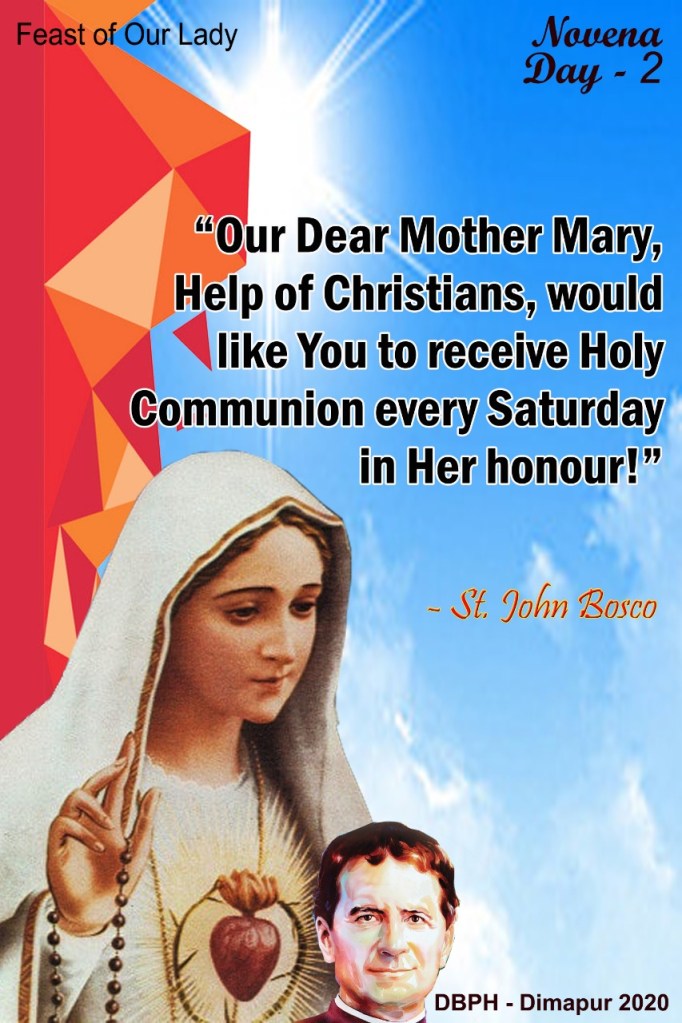
Second Day with Mary Help of Christians
Don Bosco assures us that the Virgin Mary, Help of Christians imparts a special blessing on those who take care of youth (cf. BM XVI,186). Just as Jesus showed signs of particular affection and tenderness for the young, so too is Mary’s maternal kindness focused on them. For this reason, when the Lord first revealed to John Bosco his unique call for the salvation of the young, in the prophetic dream which he had at nine years of age, he assured John that: “I will give you the Teacher”; and Mary, taking John kindly by the hand, referred to all the children in that dream as “my own children”.
Like Don Bosco, we too are called by the Lord and guided by Mary’s maternal intervention to walk “side by side with the young to lead them to the Risen Lord”. In so doing, we feel that “the Virgin Mary is present in the process as a mother” (Const. 34). As she enlightened Don Bosco, she herself also enlightens us on the beauty and importance of this mission, and supports our efforts to bring it forward.
In Honour of Mary Help of Christians
Throughout the course of history, the Christian people have experienced the protection of the Virgin Mary. The title of Help of Christians, which Don Bosco associated with that of Mary, Mother of the Church is an indication of the special intervention of Mary in the most difficult trials of personal human life, of the Church, and of the whole human family. The title of Mary Help of Christians was present in 1500 in the Loreto litanies, and Pope Pius VII initiated the celebration of Mary Help of Christians, fixing the date as May 24th, the day of his return to Rome after liberation from Napoleonic imprisonment in 1814.
Devotion to Mary Help of Christians was spread far and wide through the work of St. John Bosco and continues to be propagated in the world by the Salesian family which recognizes and invokes Mary Help of Christians as its principal patroness. From the very beginning, St. John Bosco, the great educator, placed his work as a priest and founder under the protection of Mary Help of Christians, to whom he turned for every need. His confidence in Our Lady’s help and protection was greatest when when things were difficult or confusing, and he would often turn to her, saying, “So, shall we begin to do something? “. Don Bosco placed the Institutes he founded under her maternal protection: the Congregation of St. Francis de Sales, called “the Salesians of Don Bosco”, and the “Daughters of Mary Help of Christians,” Sisters established with the collaboration of St. Mary Domenica Mazzarello, and finally, the “Salesian Cooperators,” for lay people and priests who want to live the charism of Don Bosco. Our Lady Help of Christians is therefore inseparable from the great Salesian Family, which has given the Church a host of Saints, Blesseds, Venerables and Servants of God. In 1862, Don Bosco said to Fr. Cagliero, one of his early Salesians, “Our Lady wants us to honor her with the title of Mary Help of Christians. The times are so sad that we need the Holy Virgin to help us preserve and defend the Christian faith”.
 Salesian Province of Dimapur (IND)