
Salesian who Loved Arunachal People Dies
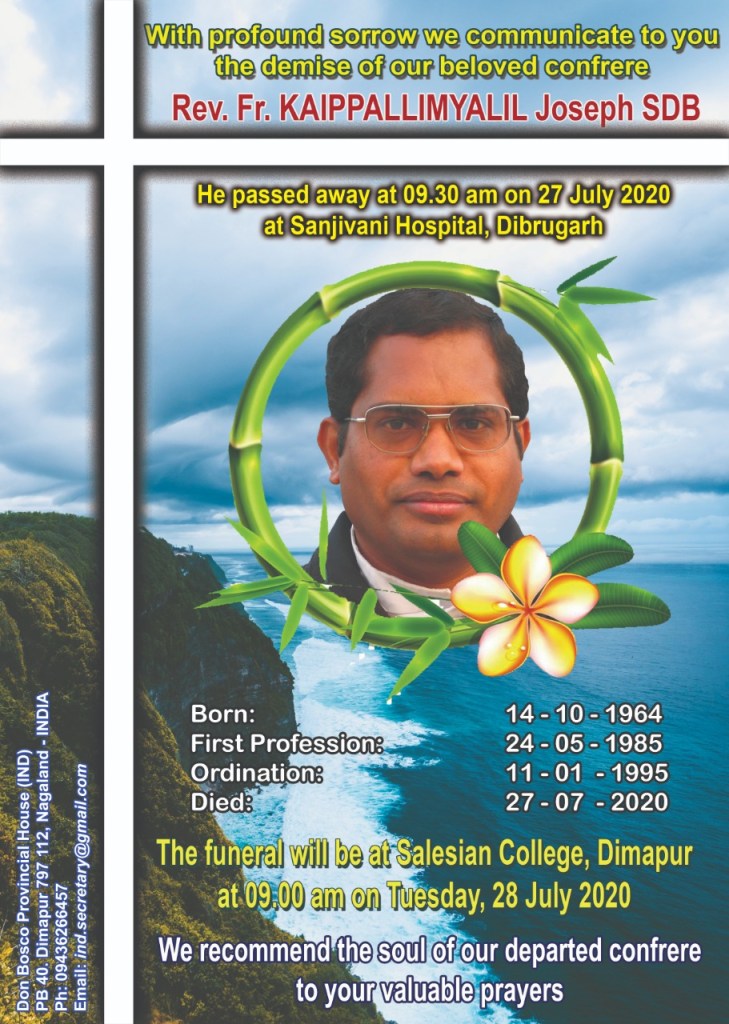

Dimapur: It is with a heavy heart that I communicate to you the passing away of Fr. KAIPPALLIMYALIL Joseph SDB (Jose Chacko), 56, at 9.30 am at Sanjivani Hospital, Dibrugarh due to a massive heart attack. He was at Injan hospital (Diocesan Hospital) in Arunachal Pradesh. Since his condition aggravated, we transferred him to Dibrugarh for better medical care. Kindly remember the departed soul in your prayers. Funeral details will be communicated a little later.

Today, 3rd June 2020, St. John Bosco Parish, Khoupum has contributed some food items to the S.D.O. of Khoupum, for those quarantined people under his supervision. The items are two bags rice, one bag of dal and one bag of fresh cabbage from our own garden. Although the quantity is small it is a gesture of solidarity with the brotheren who are in quarantined. Whatever help during this period of Covid – 19 Pandemic is welcome gesture. Kudos to the Salesian Community at Khoupum.
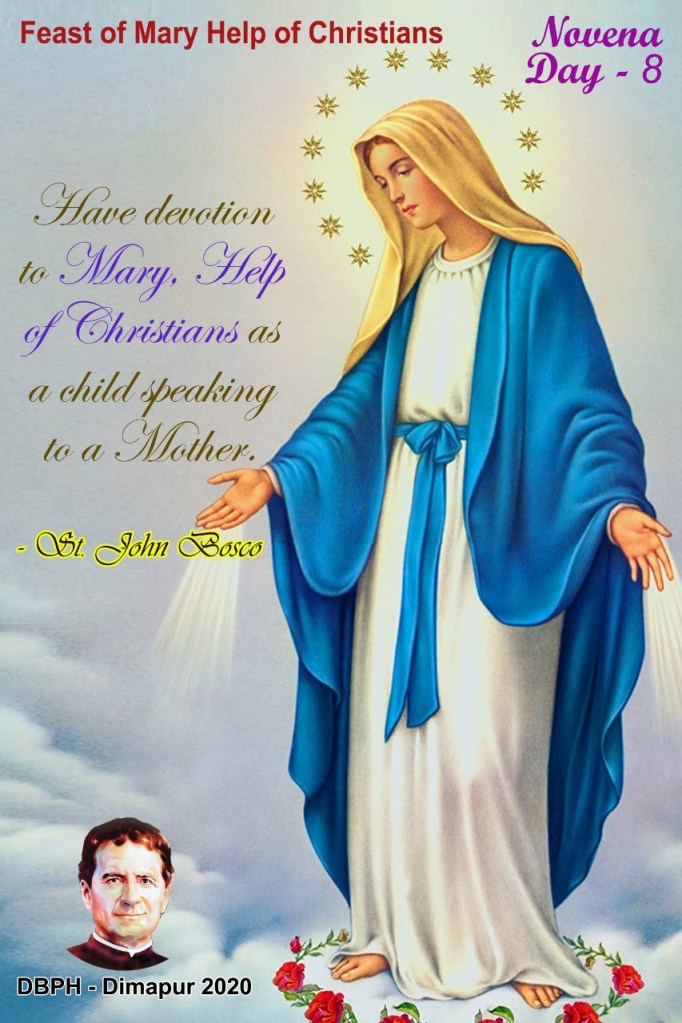
We wish all the readers of this blog of the Province a very happy feast of Mary Help of Christians. Mary comes to our aid whenever we call on him. She is actively present in the lives of everyone of us. Turn to her, and she will draw close to us.
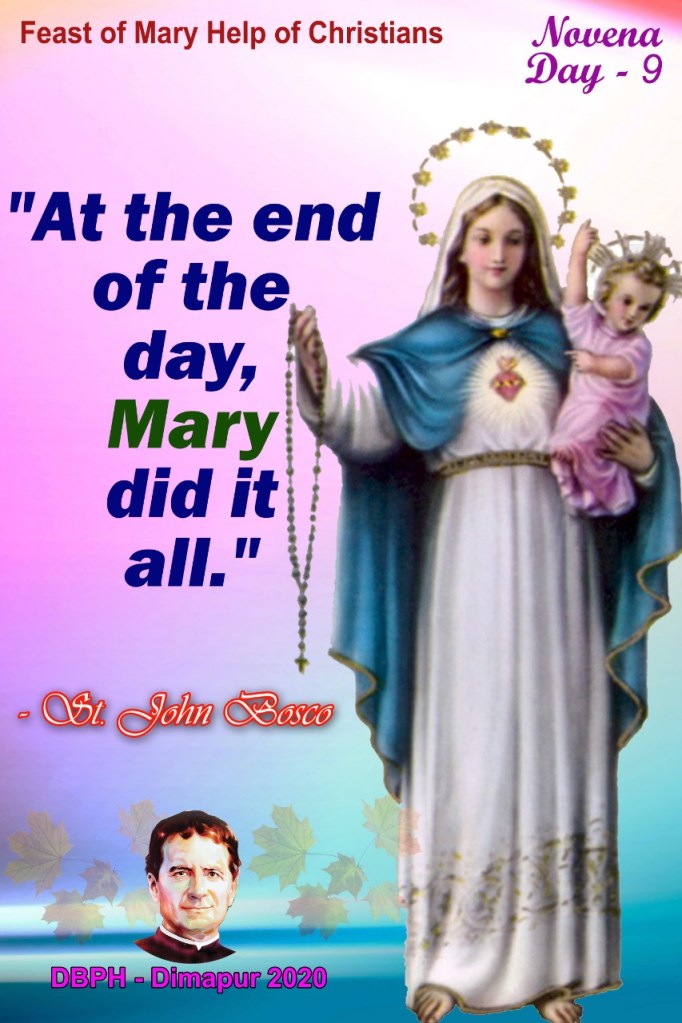
Mary, the Mother who cared for Jesus, now cares with maternal affection and pain for this wounded world. Just as her pierced heart mourned the death of Jesus, so now she grieves for the sufferings of the crucified poor and for the creatures of this world laid waste by human power. Completely transfigured, she now lives with Jesus, and all creatures sing of her fairness. She is the Woman, “clothed in the sun, with the moon under her feet, and on her head a crown of twelve stars” (Rev 12,1). Carried up into heaven, she is the Mother and Queen of all creation. In her glorified body, together with the Risen Christ, part of creation has reached the fullness of its beauty. She treasures the entire life of Jesus in her heart (cf. Lk 2,19.51), and now understands the meaning of all things. Hence, we can ask her to enable us to look at this world with eyes of wisdom.
At her side in the Holy Family of Nazareth, stands the figure of Saint Joseph. Through his work and generous presence, he cared for and defended Mary and Jesus, delivering them from the violence of the unjust by bringing them to Egypt. The Gospel presents Joseph as a just man, hard-working and strong. But he also shows great tenderness, which is not a mark of the weak but of those who are genuinely strong, fully aware of reality and ready to love and serve in humility. That is why Joseph was proclaimed custodian of the universal Church. He too can teach us how to show care; he can inspire us to work with generosity and tenderness in protecting this world which God has entrusted to us. (Francis, Laudato Si’ 241-242)
Jesus’ gift to his people
On the cross, when Jesus endured in his own flesh the dramatic encounter of the sin of the world and God’s mercy, he could feel at his feet the consoling presence of his mother and his friend. At that crucial moment, before fully accomplishing the work which his Father had entrusted to him, Jesus said to Mary: “Woman, here is your son”. Then he said to his beloved friend: “Here is your mother” (Jn 19,26-27). These words of the dying Jesus are not chiefly the expression of his devotion and concern for his mother; rather, they are a revelatory formula which manifests the mystery of a special saving mission. Jesus left us his mother to be our mother. Only after doing so did Jesus know that “all was now finished” (Jn 19,28). At the foot of the cross, at the supreme hour of the new creation, Christ led us to Mary. He brought us to her because he did not want us to journey without a mother, and our people read in this maternal image all the mysteries of the Gospel. The Lord did not want to leave the Church without this icon of womanhood. Mary, who brought him into the world with great faith, also accompanies “the rest of her offspring, those who keep the commandments of God and bear testimony to Jesus” (Rev 12,17).
The close connection between Mary, the Church and each member of the faithful, based on the fact that each in his or her own way brings forth Christ, has been beautifully expressed by Blessed Isaac of Stella: “In the inspired Scriptures, what is said in a universal sense of the virgin mother, the Church, is understood in an individual sense of the Virgin Mary… In a way, every Christian is also believed to be a bride of God’s word, a mother of Christ, his daughter and sister, at once virginal and fruitful… Christ dwelt for nine months in the tabernacle of Mary’s womb. He dwells until the end of the ages in the tabernacle of the Church’s faith. He will dwell forever in the knowledge and love of each faithful soul”.
Mary was able to turn a stable into a home for Jesus, with poor swaddling clothes and an abundance of love. She is the handmaid of the Father who sings his praises. She is the friend who is ever concerned that wine not be lacking in our lives. She is the woman whose heart was pierced by a sword and who understands all our pain. As mother of all, she is a sign of hope for peoples suffering the birth pangs of justice. She is the missionary who draws near to us and accompanies us throughout life, opening our hearts to faith by her maternal love. As a true mother, she walks at our side, she shares our struggles and she constantly surrounds us with God’s love. Through her many titles, often linked to her shrines, Mary shares the history of each people which has received the Gospel and she becomes a part of their historic identity. Many Christian parents ask that their children be baptized in a Marian shrine, as a sign of their faith in her motherhood which brings forth new children for God. There, in these many shrines, we can see how Mary brings together her children who with great effort come as pilgrims to see her and to be seen by her. Here they find strength from God to bear the weariness and the suffering in their lives. As she did with Juan Diego, Mary offers them maternal comfort and love, and whispers in their ear: “Let your heart not be troubled… Am I not here, who am your Mother?” (Francis, Evangelii gaudium 285-286)
From the relationship between the Eucharist and the individual sacraments, and from the eschatological significance of the sacred mysteries, the overall shape of the Christian life emerges, a life called at all times to be an act of spiritual worship, a self-offering pleasing to God. Although we are all still journeying towards the complete fulfilment of our hope, this does not mean that we cannot already gratefully acknowledge that God’s gifts to us have found their perfect fulfilment in the Virgin Mary, Mother of God and our Mother. Mary’s Assumption body and soul into heaven is for us a sign of sure hope, for it shows us, on our pilgrimage through time, the eschatological goal of which the sacrament of the Eucharist enables us even now to have a foretaste.
In Mary most holy, we also see perfectly fulfilled the “sacramental” way that God comes down to meet his creatures and involves them in his saving work. From the Annunciation to Pentecost, Mary of Nazareth appears as someone whose freedom is completely open to God’s will. Her immaculate conception is revealed precisely in her unconditional docility to God’s word. Obedient faith in response to God’s work shapes her life at every moment. A virgin attentive to God’s word, she lives in complete harmony with his will; she treasures in her heart the words that come to her from God and, piecing them together like a mosaic, she learns to understand them more deeply (cf. Lk 2,19.51); Mary is the great Believer who places herself confidently in God’s hands, abandoning herself to his will. This mystery deepens as she becomes completely involved in the redemptive mission of Jesus. In the words of the Second Vatican Council, “the blessed Virgin advanced in her pilgrimage of faith, and faithfully persevered in her union with her Son until she stood at the Cross, in keeping with the divine plan (cf. Jn 19,25), suffering deeply with her only-begotten Son, associating herself with his sacrifice in her mother’s heart, and lovingly consenting to the immolation of the victim who was born of her. Finally, she was given by the same Christ Jesus, dying on the Cross, as a mother to his disciple, with these words: ‘Woman, behold your Son’.” From the Annunciation to the Cross, Mary is the one who received the Word, made flesh within her and then silenced in death. It is she, lastly, who took into her arms the lifeless body of the one who truly loved his own “to the end” (Jn 13,1).
Consequently, every time we approach the Body and Blood of Christ in the eucharistic liturgy, we also turn to her who, by her complete fidelity, received Christ’s sacrifice for the whole Church. The Synod Fathers rightly declared that “Mary inaugurates the Church’s participation in the sacrifice of the Redeemer.” She is the Immaculata, who receives God’s gift unconditionally and is thus associated with his work of salvation. Mary of Nazareth, icon of the nascent Church, is the model for each of us, called to receive the gift that Jesus makes of himself in the Eucharist.
(Benedict XVI, Sacramentum caritatis 33)
“Mater Verbi et Mater laetitiae”
The close relationship between God’s word and joy is evident in the Mother of God. Let us recall the words of Saint Elizabeth: “Blessed is she who believed that there would be a fulfilment of what was spoken to her by the Lord” (Lk 1,45). Mary is blessed because she has faith, because she believed, and in this faith she received the Word of God into her womb in order to give him to the world. The joy born of the Word can now expand to all those who, by faith, let themselves be changed by God’s word. The Gospel of Luke presents this mystery of hearing and joy in two texts. Jesus says: “My mother and my brothers are those who hear the word of God and do it” (8,21). And in reply to a woman from the crowd who blesses the womb that bore him and the breasts that nursed him, Jesusreveals the secret of true joy: “Blessed rather are those who hear the word of God and obey it!” (11,28). Jesus points out Mary’s true grandeur, making it possible for each of us to attain that blessedness which is born of the word received and put into practice. I remind all Christians that our personal and communal relationship with God depends on our growing familiarity with the word of God. Finally, I turn to every man and woman, including those who have fallen away from the Church, who have left the faith or who have never heard the proclamation of salvation. To everyone the Lord says: “Behold, I stand at the door and knock; if anyone hears my voice and opens the door, I will come in to him and eat with him, and he with me” (Rev 3,20).
May every day of our lives thus be shaped by a renewed encounter with Christ, the Word of the Father made flesh: he stands at the beginning and the end, and “in him all things hold together” (Col 1,17). Let us be silent in order to hear the Lord’s word and to meditate upon it, so that by the working of the Holy Spirit it may remain in our hearts and speak to us all the days of our lives. In this way the Church will always be renewed and rejuvenated, thanks to the word of the Lord which remains forever (cf. 1 Pet 1,25; Is 40,8). Thus, we too will enter into the great nuptial dialogue which concludes sacred Scripture: “The Spirit and the bride say: ‘Come’. And let everyone who hears say: ‘Come!’” The one who testifies to these things, says: ‘Surely I am coming soon!’ Amen. Come, Lord Jesus!” (Rev 22,17.20)
(Benedict XVI, Verbum Domini 124)
Mary, Star of Hope
With a hymn composed in the eighth or ninth century, thus for over a thousand years, the Church has greeted Mary, the Mother of God, as “Star of the Sea”: Ave Maris Stella. Human life is a journey. Towards what destination? How do we find the way? Life is like a voyage on the sea of history, often dark and stormy, a voyage in which we watch for the stars that indicate the route. The true stars of our life are the people who have lived good lives. They are lights of hope. Certainly, Jesus Christ is the true light, the sun that has risen above all the shadows of history. But to reach him we also need lights close by—people who shine with his light and so guide us along our way. Who more than Mary couldbe a star of hope for us? With her “yes” she opened the door of our world to God himself; she became the living Ark of the Covenant, in whom God took flesh, became one of us, and pitched his tent among us (cf. Jn 1,14).
So we cry to her: Holy Mary, you belonged to the humble and great souls of Israel who, like Simeon, were “looking for the consolation of Israel” (Lk 2,25) and hoping, like Anna, “for the redemption of Jerusalem” (Lk 2,38). Your life was thoroughly imbued with the sacred scriptures of Israel which spoke of hope, of the promise made to Abraham and his descendants (cf. Lk 1,55). In this way we can appreciate the holy fear that overcame you when the angel of the Lord appeared to you and told you that you would give birth to the One who was the hope of Israel, the One awaited by the world. Through you, through your “yes”, the hope of the ages became reality, entering this world and its history. You bowed low before the greatness of this task and gave your consent: “Behold, I am the handmaid of the Lord; let it be to me according to your word” (Lk 1,38). When you hastened with holy joy across the mountains of Judea to see your cousin Elizabeth, you became the image of the Church to come, which carries the hope of the world in her womb across the mountains of history. But alongside the joy which, with your Magnificat, you proclaimed in word and song for all the centuries to hear, you also knew the dark sayings of the prophets about the suffering of the servant of God in this world. Shining over his birth in the stable at Bethlehem, there were angels in splendour who brought the good news to the shepherds, but at the same time the lowliness of God in this world was all too palpable. The old man Simeon spoke to you of the sword which would pierce your soul (cf. Lk 2,35), of the sign of contradiction that your Son would be in this world. Then, when Jesus began his public ministry, you had to step aside, so that a new family could grow, the family which it was his mission to establish and which would be made up of those who heard his word and kept it (cf. Lk 11,27f). Notwithstanding the great joy that marked the beginning of Jesus’s ministry, in the synagogue of Nazareth you must already have experienced the truth of the saying about the “sign of contradiction”(cf. Lk 4,28ff). In this way you saw the growing power of hostility and rejection which built up around Jesus until the hour of the Cross, when you had to look upon the Saviour of the world, the heir of David, the Son of God dying like a failure, exposed to mockery, between criminals. Then you received the word of Jesus: “Woman, behold, your Son!” (Jn 19,26) From the Cross you received a new mission. From the Cross you became a mother in a new way: the mother of all those who believe in your Son Jesus and wish to follow him. The sword of sorrow pierced your heart. Did hope die? Did the world remain definitively without light, and life without purpose? At that moment, deep down, you probably listened again to the word spoken by the angel in answer to your fear at the time of the Annunciation: “Do not be afraid, Mary!” (Lk 1,30) How many times had the Lord, your Son, said the same thing to his disciples: “do not be afraid”! In your heart, you heard this word again during the night of Golgotha. Before the hour of his betrayal he had said to his disciples: “Be of good cheer, I have overcome the world” (Jn 16,33). “Let not your hearts be troubled, neither let them be afraid” (Jn 14,27). “Do not be afraid, Mary!” In that hour at Nazareth the angel had also said to you: “Of his kingdom there will be no end” (Lk 1,33). Could it have ended before it began? No, at the foot of the Cross, on the strength of Jesus’s own word, you became the mother of believers. In this faith, which even in the darkness of Holy Saturday bore the certitude of hope, you made your way towards Easter morning. The joy of the Resurrection touched your heart and united you in a new way to the disciples, destined to become the family of Jesus through faith. In this way you were in the midst of the community of believers, who in the days following the Ascension prayed with one voice for the gift of the Holy Spirit (cf. Acts 1,14) and then received that gift on the day of Pentecost. The “Kingdom” of Jesus was not as might have been imagined. It began in that hour, and of this “Kingdom” there will be no end. Thus, you remain in the midst of the disciples as their Mother, as the Mother of hope. Holy Mary, Mother of God, our Mother, teach us to believe, to hope, to love with you. Show us the way to his Kingdom! Star of the Sea, shine upon us and guide us on our way.
(Benedict XVI, Spe salvi, 49-50)
 Salesian Province of Dimapur (IND)